


Beyond Sustainable Aviation Fuel: Why Fuel Composition Matters
By Myfanwy Fleming-Jones

The Next Opportunity in Aviation Sustainability
Global aviation consumes more than 300 billion litres of fuel each year. As the industry works towards lower-emission flight, significant attention has been placed on how sustainable aviation fuels are produced. Considerable progress has been made in converting waste streams, biomass and synthetic feedstocks into fuels capable of satisfying recognised aviation fuel specifications.
At Avioxx, we believe the next major opportunity may not lie solely in fuel production, but in fuel design.
Our work is focused on understanding how molecular fuel composition influences emissions, fuel properties and production economics, and whether these relationships can be used to engineer better aviation fuels. While enormous effort has been invested in developing sustainable fuel pathways, comparatively little attention has been given to the fact that multiple fuels can satisfy the same aviation fuel specification whilst exhibiting materially different combustion characteristics, emissions profiles and atmospheric behaviours.
This creates an opportunity to move beyond simply producing compliant aviation fuel and towards optimising fuel composition itself.
Looking Beyond Fuel Specifications
Aviation fuel specifications are among the most rigorous in the world. ASTM and DEF STAN requirements ensure that fuels can be safely used across a global fleet of aircraft, engines and fuel systems.
However, fuel specifications were never designed to ensure that every compliant fuel behaves identically.
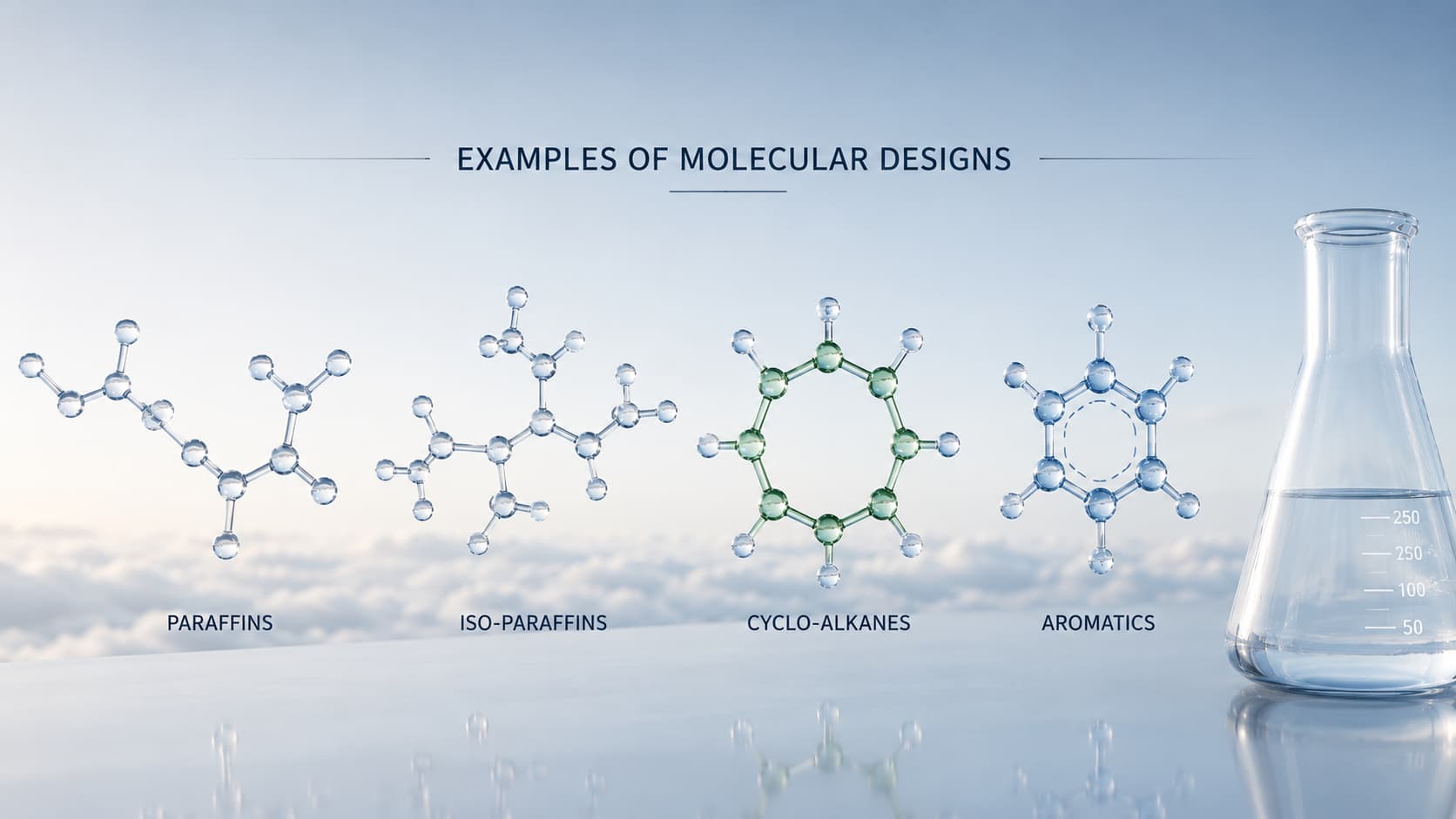
Two fuels can satisfy the same Jet A1 specification while containing significantly different distributions of paraffins, iso-paraffins, cyclo-alkanes and aromatics. Although both fuels may be considered compliant, they can exhibit different combustion behaviour, soot formation tendencies and particulate emissions characteristics.
Historically, compliance has often been viewed as the finish line. We believe it may be the starting point.
Once a fuel satisfies the required specification, a much larger engineering question emerges: which compliant fuel composition delivers the best balance between environmental performance, fuel properties and production economics?
From Fuel Production to Fuel Optimisation
The aviation industry has understandably focused on developing new fuel-production pathways and understanding the emissions characteristics of sustainable aviation fuels. These areas remain critically important.
Yet a significant gap remains between fuel production and fuel performance.
Any future aviation fuel must satisfy multiple competing objectives simultaneously. It must meet stringent specification requirements, maintain appropriate density and lubricity, preserve compatibility with existing fuel systems, operate reliably at low temperatures and deliver predictable combustion performance. At the same time, there is increasing pressure to reduce soot formation, particulate emissions and broader non-CO₂ climate impacts.
Improving one characteristic may negatively affect another.
Reducing aromatic content may improve emissions performance but influence density and seal compatibility. Increasing certain hydrocarbon classes may improve one fuel property whilst degrading another. The challenge therefore becomes one of optimisation rather than simple compliance.
Why Artificial Intelligence Matters
The complexity of this problem makes it particularly well suited to data-driven engineering approaches.
Artificial intelligence provides a mechanism for understanding relationships that are difficult to identify through conventional testing alone. By combining molecular composition data, fuel-property measurements, combustion testing and emissions analysis, predictive models can be developed that describe how fuel composition influences both fuel behaviour and environmental performance.
Rather than evaluating individual fuels one by one, researchers can begin to explore large regions of molecular design space and identify compositions that satisfy multiple constraints simultaneously.
At Avioxx, the objective is not simply to identify lower-emission fuels. The objective is to identify fuel compositions that balance emissions performance, fuel-property requirements and practical manufacturability.
This creates the foundation for a fundamentally different approach to fuel development, where predictive models help identify promising compositions before they are manufactured and validated experimentally.
The Importance of Process-Constrained Optimisation
A significant limitation of many fuel optimisation studies is the assumption that fuel composition can be varied freely.
Every fuel composition must be achievable through a physical production process.
Reactor design, catalyst selection, upgrading configurations, separation performance and process economics all constrain the range of fuel mixtures that can realistically be produced. A fuel composition that appears attractive in theory may be impossible to manufacture efficiently or may require unacceptable capital or operating costs.
This creates a fundamentally different optimisation problem.
Rather than searching for an ideal fuel composition in isolation, the objective becomes identifying fuel compositions that simultaneously satisfy aviation fuel requirements, minimise environmental impact and remain achievable within the practical and economic constraints of real-world production systems.
We believe this concept of process-constrained fuel optimisation represents one of the most important and least explored opportunities in future aviation fuel development.
Cyclo-Alkanes as an Example
Cyclo-alkanes provide a useful illustration of the broader optimisation challenge.
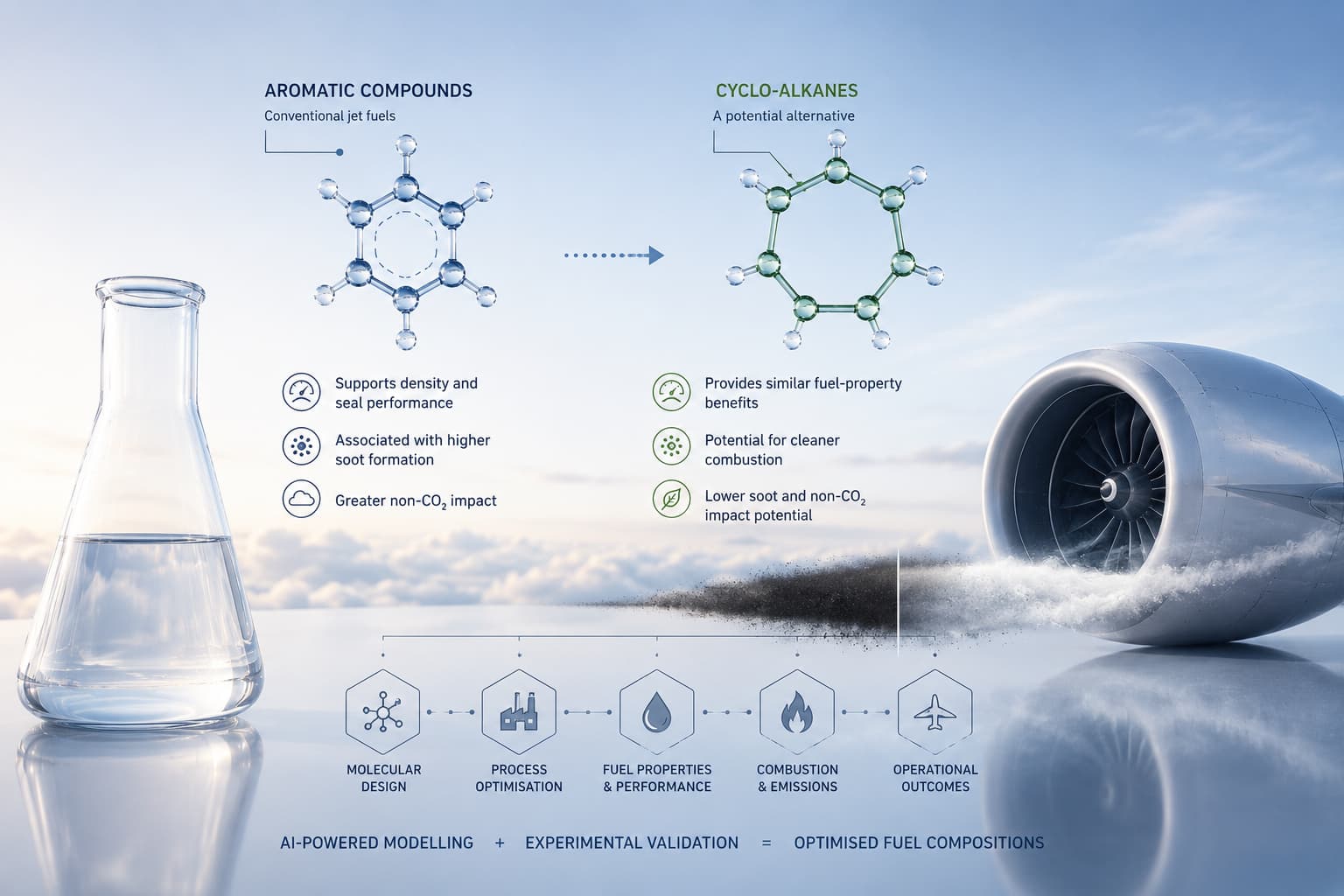
Conventional jet fuels contain aromatic compounds that contribute to density and support elastomer seal performance within fuel systems. Unfortunately, aromatics are also associated with increased soot formation during combustion.
Cyclo-alkanes may offer an alternative route.
These molecules can provide similar fuel-property benefits while potentially exhibiting cleaner combustion behaviour. Production pathways and upgrading strategies can be adjusted to favour cyclo-alkane formation, creating opportunities to improve environmental performance without compromising key fuel requirements.
Whether cyclo-alkanes ultimately prove to be the optimal solution is less important than what they represent: a demonstration that molecular composition can be deliberately engineered to influence both operational performance and environmental outcomes.
The same methodology can be applied across thousands of potential fuel compositions and combinations of hydrocarbon classes, helping identify opportunities that would be difficult to discover through conventional experimental approaches alone.
Why This Matters to Industry
For airlines, fuel producers and aerospace OEMs, fuel composition optimisation has implications far beyond laboratory performance.
For fuel producers, improved understanding of molecular composition may help maximise the value extracted from feedstocks, improve product quality and reduce reliance on expensive downstream processing.
For airlines and aircraft operators, improved fuel compositions may contribute to lower non-CO₂ impacts while maintaining compatibility with existing aircraft and infrastructure.
For aerospace manufacturers and engine developers, deeper understanding of the relationship between fuel composition, emissions and fuel properties can support future propulsion development, fuel qualification activities and environmental performance assessment.
As sustainable aviation fuel production scales globally, the ability to optimise fuel composition rather than simply fuel production may become an increasingly important source of competitive advantage.
Building on Real Operational Data
The availability of real operational data is essential to making this approach viable.
Unlike purely theoretical optimisation studies, Avioxx already operates integrated fuel-production and validation systems capable of generating physical fuel samples, molecular composition data, fuel-property measurements and process-operating data.
These datasets provide the foundation for developing predictive models capable of linking production conditions, molecular composition and downstream performance.
As these datasets expand, the ability to identify and validate improved fuel compositions becomes increasingly powerful.
Rather than relying solely on simulation, optimisation can be informed by physical fuel production, testing and validation, creating a continuous learning framework capable of accelerating fuel development.
Towards Intelligent Fuel Design
Future aviation sustainability will require more than simply replacing fossil-derived fuels with sustainable alternatives.
The next challenge is understanding which molecular compositions deliver the best balance between environmental impact, fuel performance and manufacturability.
By combining fuel production, molecular characterisation, emissions analysis and process-constrained optimisation, it becomes possible to move beyond fuel substitution and towards intelligent fuel design.
The future of aviation fuels may not be defined solely by how they are produced.
It may be defined by how intelligently they are optimised.