


The transition from pilot plant to institutional infrastructure
By Myfanwy Fleming-Jones

A national-scale environmental and energy security programme becomes bankable when investors, lenders and strategic counterparties are prepared to commit capital based on contracted revenues, predictable long-term cash flows and a clearly defined risk management framework.
In sustainable energy, that means the risks have been identified, understood and reduced to a level that gives confidence in both the technology and the commercial model behind it.
Within Sustainable Aviation Fuel (SAF), many companies can now point to pilot schemes, real data and proven innovation. Far fewer can demonstrate the operational performance, supply chain certainty and revenue visibility needed to attract long-term project finance.
That is the challenge the Avioxx team in Cheshire, UK, has set out to solve. Their focus is not simply on producing fuel from abundant feedstocks, but on developing SAF capable of scaling into commercial scale financeable production capacity aligned with UK aviation decarbonisation policy.
SAF is seen as essential to decarbonising aviation because it can reduce lifecycle greenhouse gas emissions by around 70% compared with fossil jet fuel. Fuel users can then earn certificates linked to the emissions savings of the SAF they use, creating further commercial incentives for lower-carbon fuels.
Avioxx has demonstrated this through independent analysis carried out with Intertek, which confirmed that approximately 54% of Avioxx fuel falls within the kerosene range required for jet fuel. In practical terms, this demonstrates that waste-derived feedstocks are being converted into aviation-range hydrocarbons through a live continuous process rather than a laboratory-only concept.
For investors and industry stakeholders, this distinction matters as laboratory concepts alone do not create financeable projects. Demonstrated operational performance, repeatable outputs, secured feedstock pathways and credible engineering execution plans are what move a project from early-stage innovation into infrastructure capable of supporting institutional investment and senior lender participation.
The next stage for Avioxx is progressing toward financeability for its first commercial-scale FOAK facility, structured as a fully modelled infrastructure project with defined EPC planning, feedstock strategy and identified long-term demand.
Institutional finance platform for sustainable aviation fuel
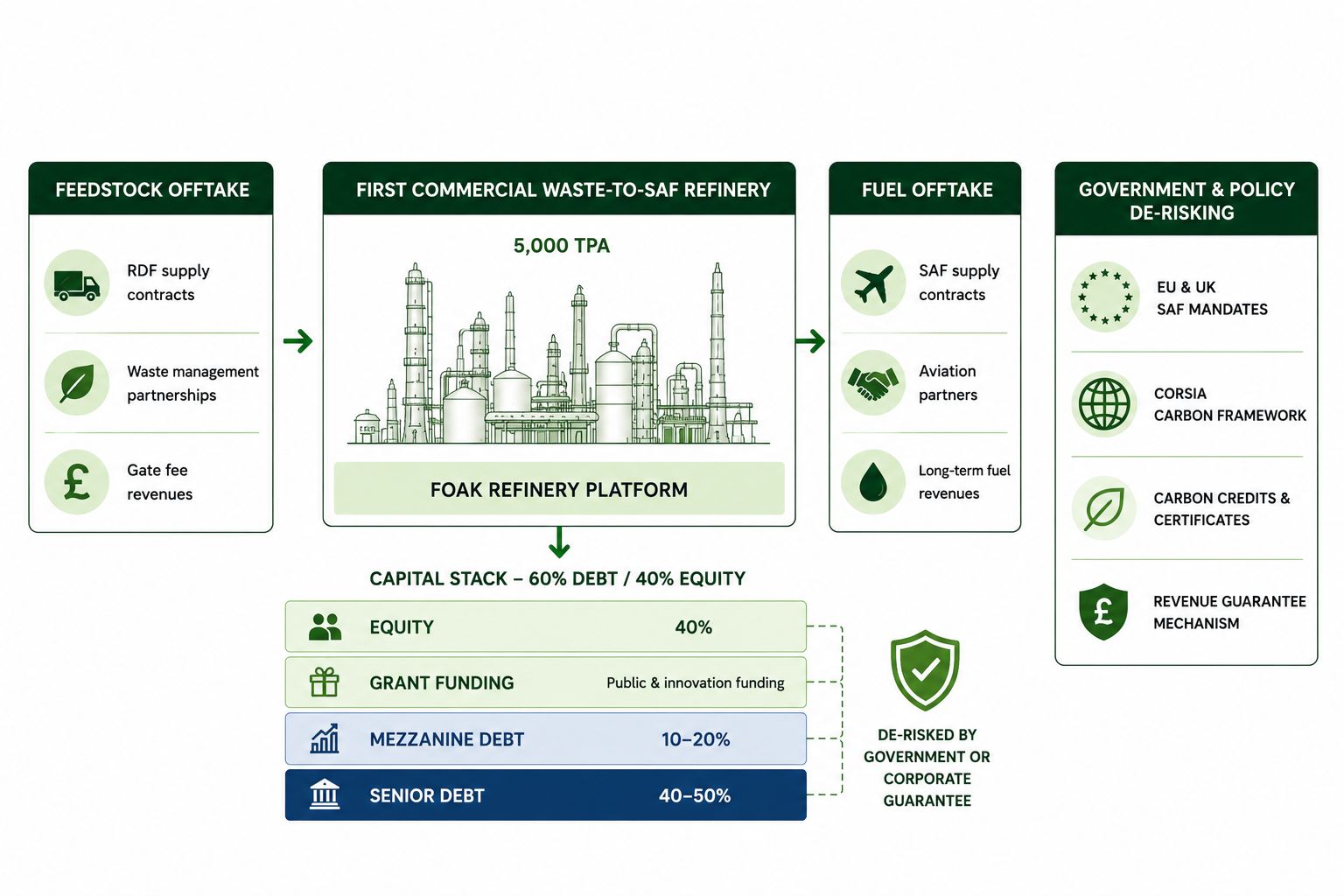
Achieving this would allow Avioxx to move beyond pilot operations and begin large-scale fuel production aligned with the UK’s SAF ambitions and blending mandates.
These mandates were set by the UK Government with a target for at least 10% of aviation fuel to come from sustainable sources by 2030, creating significant long-term demand for domestic SAF production capacity.
At its core, Avioxx is developing a green fuels system designed with commercial deployment in mind. Over the past year, NIRAS has worked alongside Avioxx to help bridge the gap between pilot-stage technology and a First of a Kind (FOAK) facility. This has included EPC-focused planning, supplier engagement, cost definition and the development of a clearer execution pathway for scale-up.
“It’s encouraging to see a pathway emerging towards a genuinely bankable FOAK infrastructure project, with the right commercial, policy and financing structures being developed to de-risk deployment for institutional investors while still rewarding early-stage capital and strategic partners backing innovation at this stage,” says Jim Buston, Green Fuel Projects Director.
As the UK SAF market matures, financing structures are also expected to evolve around revenue certainty mechanisms, long-term offtake agreements and potentially government-supported credit guarantee structures capable of materially reducing downside exposure for lenders and infrastructure investors.
A project with secured feedstock, identified offtake demand and a clearly structured risk management framework presents a materially more financeable proposition capable of supporting long-term institutional investment and attractive risk-adjusted returns.
Airlines, governments and fuel suppliers are all under pressure to decarbonise aviation, yet the industry will only scale at pace if projects can demonstrate dependable infrastructure and predictable returns.
According to the International Air Transport Association (IATA), SAF could contribute around 65% of the emissions reductions required for aviation to achieve net zero by 2050, but this depends heavily on production scaling from demonstration plants into commercial facilities.
Engagement with engineering partners, strategic counterparties and financial institutions is already underway as part of preparations for construction-stage financing and long-term project delivery.
Private capital is also beginning to recognise the opportunity. Infrastructure funds, strategic investors and lenders are showing growing interest in SAF, particularly where projects can demonstrate credible technology, strong engineering partnerships and long-term market demand. The projects most likely to succeed will be those that combine innovation with operational discipline and commercial clarity.
Avioxx’s approach reflects that shift. The objective is not simply to prove a pilot-stage technology, but to establish commercially financeable SAF infrastructure capable of delivering long-duration fuel production capacity, predictable operating performance and strategic value within the UK’s future aviation energy system.
As SAF markets mature, the projects most likely to succeed will be those capable of combining operational performance, commercial clarity and infrastructure-grade execution at scale.