


Gasification Has Changed.
It’s Time the Conversation Did Too.
By Myfanwy Fleming-Jones
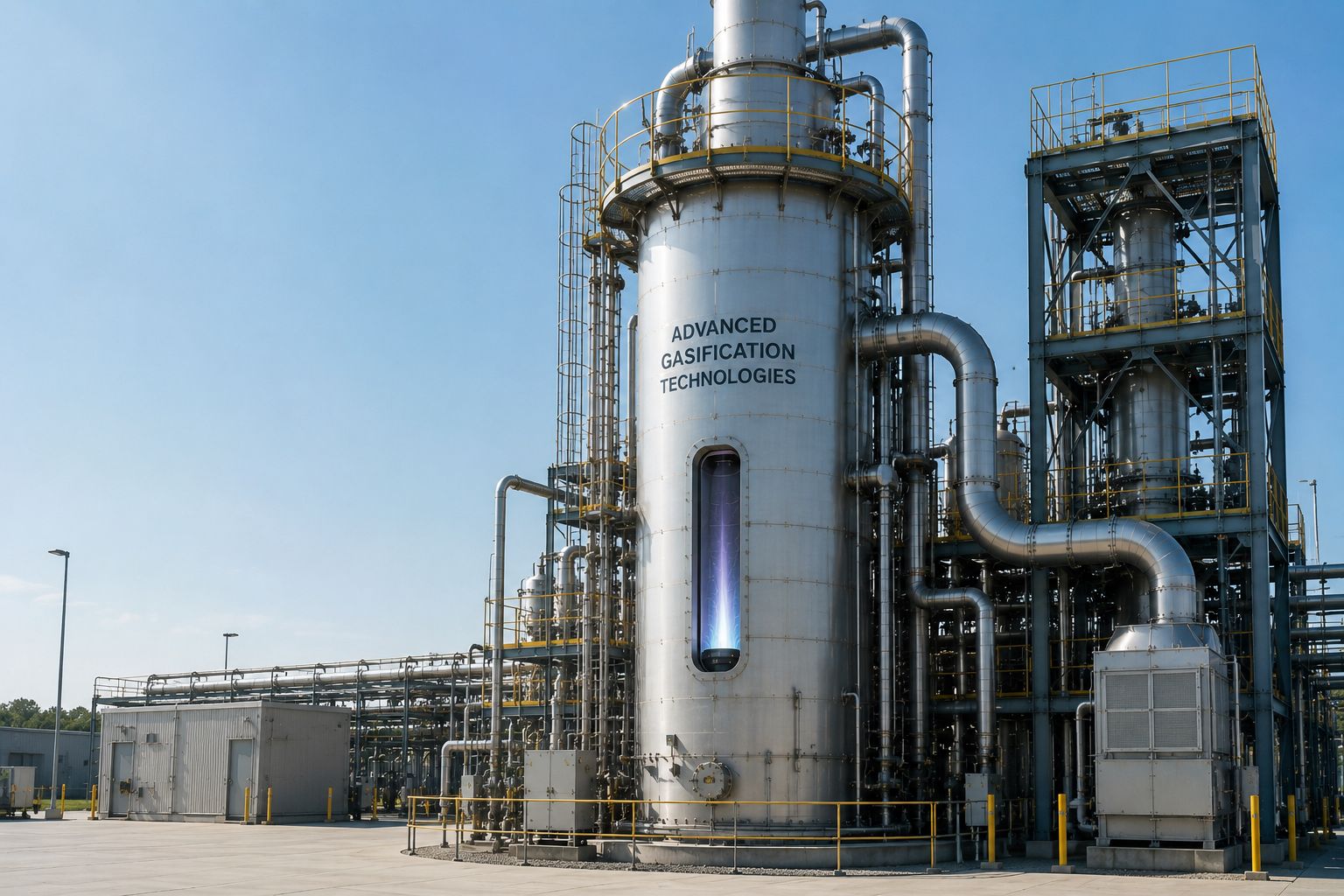
How decades of engineering innovation are transforming one of the world’s oldest industrial technologies
For decades, gasification has occupied an unusual position within the energy industry. Although the technology is well established, its reputation has often been shaped by early demonstration projects that struggled to scale, faced operational challenges or proved difficult to finance. As a result, gasification has sometimes been viewed as technically complex and commercially risky.
That perception was understandable, but it is increasingly out of date.
We would not judge today’s offshore wind industry by the turbines installed in the 1990s or assess modern solar power using the performance of its earliest panels. Both technologies have been transformed by decades of engineering development, and gasification deserves to be considered in the same way.
Over the last 40 years in particular, improvements in reactor design, feedstock preparation, gas cleaning, materials science, automation and digital process control have significantly changed what modern gasification can achieve. Today, modern gasification provides an established industrial route for converting carbonaceous feedstocks, including certain waste streams, into synthesis gas, or syngas, which can then be used to produce Sustainable Aviation Fuel (SAF), renewable transport fuels, hydrogen and other chemicals.
This evolution can be seen in technologies such as High Temperature Winkler (HTW®) gasification. Developed over decades by Rheinbraun/RWE and ThyssenKrupp Uhde before being acquired by GIDARA Energy in 2019 and which now owns the technology and its associated intellectual property, HTW® has accumulated extensive industrial operating experience, including commercial-scale operation and campaigns using refuse-derived and plastic-rich waste feedstocks.
Several dedicated test campaigns at a currently operational testing facility in Germany have also been conducted using HTW® with biomass, RDF, and other challenging waste streams, further validating its flexibility and robustness across diverse feedstocks. This industrial heritage provides an important foundation for the latest generation of waste-to-fuels projects.
The question is therefore becoming less about whether gasification works and more about how effectively different technology platforms can operate at commercial scale, integrate with downstream processes and produce fuels competitively.
A growing waste challenge and a growing fuel challenge
The timing is particularly important because the world is facing both a growing waste problem and a growing need for low-carbon fuels.
The United Nations Environment Programme estimates that municipal solid waste generation could increase from approximately 2.1 billion tonnes today to 3.8 billion tonnes by 2050. At the same time, aviation will need substantially more Sustainable Aviation Fuel as governments introduce increasingly ambitious blending requirements.
Industry forecasts indicate that global SAF demand could reach tens of millions of tonnes annually by the mid-2030s, potentially leaving a significant supply deficit if production does not increase substantially.
Rather than treating non-recyclable municipal waste, refuse-derived fuel and waste wood solely as disposal problems, gasification can convert these materials into syngas, turning waste into a source of sustainable carbon for fuel production.
Renewi, one of Europe’s largest waste management companies, processes approximately 10 million tonnes of waste each year across multiple European markets. At this scale, even a relatively small proportion of suitable residual feedstock could support significant SAF production, illustrating the potential opportunity within Europe’s existing waste infrastructure.
The wider opportunity across Europe’s waste infrastructure is therefore considerable.
From waste to valuable molecules
Gasification works by converting the chemical energy contained within residual waste into syngas, primarily made up of hydrogen and carbon monoxide. Once cleaned and conditioned, this syngas can be used as a flexible industrial feedstock for producing SAF, renewable diesel, renewable gasoline, methanol and hydrogen.
This differs from conventional energy-from-waste, where combustion is primarily used to recover energy as heat and electricity. Gasification instead preserves the chemical value of the carbon, allowing it to be used to manufacture new products.
As the demand for sustainable fuels grows, this ability to turn waste into useful molecules could become increasingly important.
Integration is becoming the competitive advantage
Producing syngas is only the first stage of the process. For SAF production through Fischer-Tropsch synthesis, the composition of the syngas needs to be carefully managed, particularly the balance between hydrogen and carbon monoxide, while carbon utilisation must be maximised.
Avioxx has developed a different approach by integrating solid oxide fuel cell (SOFC) electrochemistry directly into its waste-to-fuels platform. The patented process is designed to increase the hydrogen available for Fischer-Tropsch synthesis while also generating renewable electricity and high-grade process heat within the system.
By making better use of the energy already present in the process, this integration has the potential to improve fuel yields and project economics while reducing reliance on externally supplied hydrogen and electricity.
The innovation is therefore not simply gasification itself. It is how established technologies can be integrated to create a more efficient route from residual waste to Sustainable Aviation Fuel.
Gasification has been evolving for decades. The next chapter will not be defined simply by the reactor itself, but by how effectively proven technologies can be integrated around it to maximise carbon utilisation, energy efficiency and fuel production.
That is where Avioxx believes the next generation of waste-to-SAF systems will be won.